Love Letter
Made by hand in Framer
- Customer sends their content
- I build the page in Framer
- I send the link to the customer
Ariya turns your photos, your words and your voice into a small interactive experience for one person, sent as a link. It started as a Valentine love letter I built by hand for each customer, and it grew into a platform anyone can use to make one themselves.
Where it started
In February 2026 I designed, built and sold a personalised digital Valentine love letter. Each customer sent me their messages, photos and audio, and I customised a Framer page for them by hand.
People paid for it, and the feedback was warm. It proved that people want to give something more personal than a text or a card.
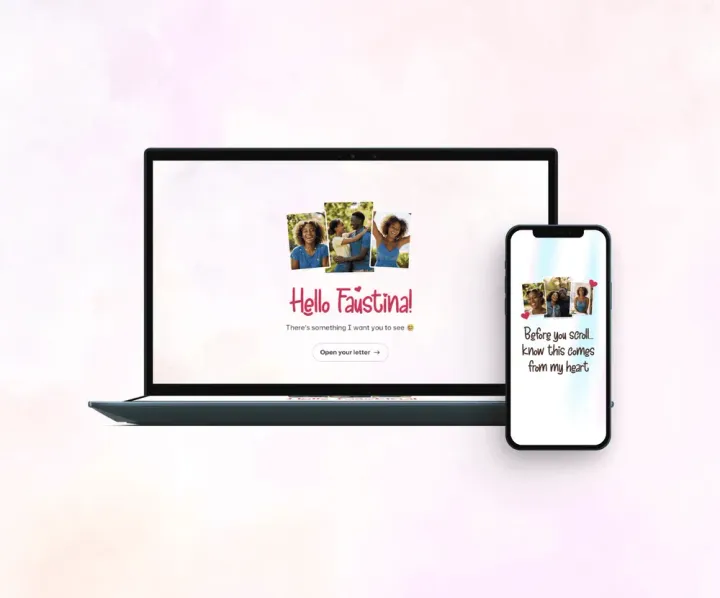
Designing, building, and launching a digital product from idea to paying customers.
The turning point
The manual approach was right for testing the idea, but every order depended on me. I collected content, built each page and delivered the link myself. That capped the business at the number of pages I could build, and only for one occasion a year.
Customer feedback pointed to the same change:
Both meant the same thing: let people build it themselves. In October 2026 I started turning the love letter into Ariya, a self-serve product for every kind of celebration.
How it evolved
Made by hand in Framer
Self-serve on Ariya
The problem
People want to do something meaningful for a birthday, an anniversary or a proposal. The options they had were:
Quick but generic. They are looked at for five seconds.
Flexible but slow, and the result looks like a website, not a gift.
Like my love letter: emotionally powerful, but out of reach for almost everyone.
The betAriya sells the third option at the effort level of the first.
The recipient's experience is the product. The builder exists to produce it.
Designing the product
Creators fill in a story; they don't design a page. Every template is a fixed format that any content fits, so it can't be made ugly. This answered the request for more control without handing people a blank canvas.
An occasion is a category (Birthday). A template is a complete experience inside it, with its own scenes and interactions (Birthday Surprise). A theme is a colour variant. One template serves every customer, and a new occasion plugs in without changing the platform.
Every template follows the same five beats: Arrival, Recognition, Discovery, Peak, Keepsake. Each has one signature moment the recipient makes happen with their hands: untying a ribbon, blowing out candles, opening an envelope.
This came straight from the customers who were uneasy sharing personal details. Nobody else builds the page. Links are unlisted and not indexed, link previews show the recipient's name but no photos, and location data is stripped from photos.
A draft starts as soon as you pick a template and stays in your browser until you publish. You only pay to publish.
Recipients open links inside WhatsApp and Instagram on any phone, so every template stays fast and light, works with reduced motion, and has a fallback when 3D isn't available.
The templates
Each template is designed as its own product, with its own story and signature moment.
A wrapped gift arrives with their name on the tag. Inside are prints of moments the sender kept, each with a note on the back.
Signature moment Making a wish and blowing out the candles
An anniversary gift in one long scroll: a letter, photos and milestones, a voice note, and one last surprise.
Signature moment Opening the sealed envelope, then a 3D gift box
An exhibition about them, walked through slowly, one exhibit at a time.
Signature moment The Full Picture: every exhibit comes together on one wall
A birthday card the whole group signs through one link.
Signature moment Opening the card to find everyone's notes inside
How it works
With the love letter, every order went through me. With Ariya, the creator does everything themselves:
Browse the templates on the home page, or search by occasion.
Full screen with sample content, exactly as the recipient will see it.
A step-by-step builder follows the template's scenes, with a live preview beside it and autosave.
Free to create and preview; payment is only needed to publish.
Copy, WhatsApp or QR code. Small fixes are possible for a short window after publishing, then the card is final.
From one person to many
The first templates were from one person to one person. With From All of Us, a whole group makes one card together.
Every contributor sees how Ariya works, and the contribute page invites them to make their own gift next. One card can bring in many new creators.
How I built it
I designed and built Ariya myself, using Claude Code as my engineering partner. The love letter needed only Framer. Ariya needed a real platform: payments, storage, a builder, publishing and security.
Every template starts as written documents: what the experience is, what content it needs, and how it looks. The code is checked against them by automated tests.
Claude Code writes and reviews code; I set direction, review every screen on a phone, and decide what ships.
The platform knows nothing about any one occasion, so a new template plugs in without touching the core.
What I learned
Selling the love letter by hand taught me what people valued before I built anything bigger. Ariya is the system that learning paid for.
The hardest part was not the code. It was deciding what creators should not have to decide. Every option I removed made the builder faster and the gifts better.
Designing for two people at once changed how I work. The creator pays, but the recipient decides whether it worked, so I reviewed every screen from both sides.
What's next: More templates for Valentine's Day, weddings and proposals.